
What is rhetorical analysis? It’s the art of dissecting the persuasive techniques woven into our everyday interactions, from the captivating pitches of advertisers to the impassioned pleas of politicians. This isn’t just an academic exercise; it’s a critical skill that empowers us to navigate the complex landscape of information and discern the underlying strategies used to sway our opinions and actions. Understanding rhetoric allows us to become more discerning consumers of information, better communicators, and more informed citizens.
Rhetorical analysis delves into the core components of persuasive communication, examining how speakers and writers use language, structure, and emotional appeals to influence their audiences. By understanding the building blocks of persuasion – ethos, pathos, and logos – we can begin to unpack the complex messages we encounter daily. Furthermore, this form of analysis also explores rhetorical devices such as metaphors, similes, and rhetorical questions, and how they contribute to the overall impact of a message. It is a systematic process that reveals the deliberate choices made to shape a message and achieve a specific outcome.
Understanding the Fundamental Nature of Rhetorical Examination in Communication
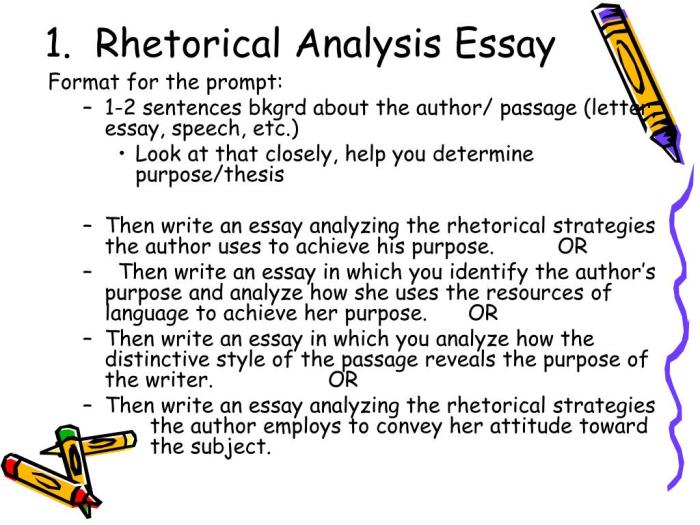
Rhetorical analysis, at its core, is the systematic dissection of persuasive communication. It’s the process of taking apart a message – a speech, an advertisement, a social media post – to understand how it works, how it achieves its goals, and what underlying strategies are employed to influence an audience. This form of examination goes beyond simply understanding the surface-level content; it delves into the techniques used to shape the audience’s perception, emotions, and ultimately, their actions. This analytical approach is crucial for navigating the constant stream of persuasive communication we encounter daily, enabling us to become more discerning consumers and more effective communicators ourselves.
The Core Purpose of Dissecting Persuasive Communication
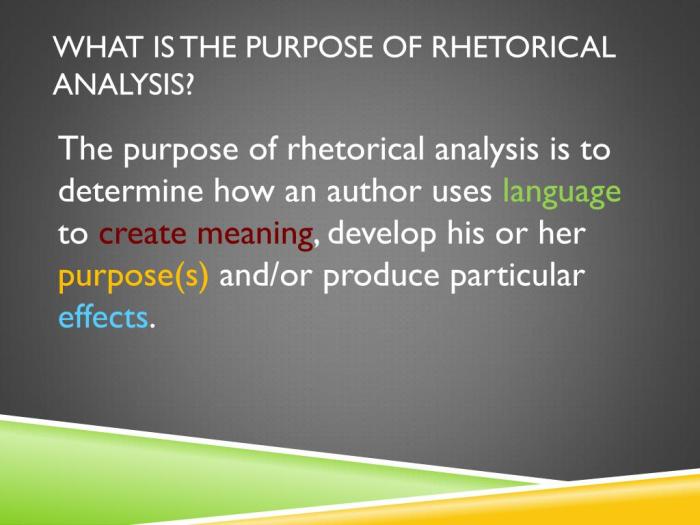
The central purpose of rhetorical examination is to uncover the mechanics of persuasion. It seeks to identify the specific choices a communicator makes – the language they use, the structure of their arguments, the appeals they employ – and how those choices contribute to the overall effectiveness of the message. This analysis reveals the underlying strategies used to shape audience perceptions, beliefs, and behaviors. By understanding these strategies, individuals can become more critical consumers of information, better equipped to recognize manipulation and make informed decisions. Furthermore, this form of examination helps individuals refine their own communication skills, allowing them to craft more persuasive and impactful messages. In essence, it is a tool for understanding and navigating the complexities of human interaction, especially where persuasion is involved.
Contexts for Application
Rhetorical analysis is applicable in a wide range of contexts, each presenting unique challenges and opportunities for persuasion. Here are some prevalent examples:
Political Speeches: Analyzing political speeches involves examining the speaker’s use of rhetoric to connect with voters, frame issues, and advance their agendas. This includes identifying the use of emotional appeals, logical arguments, and the speaker’s credibility (ethos) to influence public opinion.
Advertisements: The examination of advertising explores how persuasive techniques are used to sell products or services. This includes analyzing the use of imagery, slogans, celebrity endorsements, and appeals to consumer desires and needs. Understanding these techniques can help consumers make more informed purchasing decisions.
Social Media Posts: In the realm of social media, rhetorical analysis examines how individuals and organizations use language, images, and other forms of communication to build relationships, share information, and influence others. This includes analyzing the use of hashtags, trending topics, and persuasive narratives to shape online conversations.
Legal Arguments: Legal professionals frequently use rhetorical analysis to construct persuasive arguments in court. By carefully selecting language, organizing information, and appealing to the judge and jury, they strive to influence the outcome of a case.
Unveiling Underlying Strategies
The process of rhetorical examination unveils the underlying strategies employed to influence an audience. It dissects how communicators use various techniques to achieve their goals. Consider, for example, a politician delivering a speech on economic policy. They might use statistics to appear credible (logos), share personal anecdotes to connect with voters on an emotional level (pathos), and present themselves as trustworthy and experienced (ethos).
“The economy is strong, and we’re seeing record low unemployment. However, my opponent’s plan would devastate small businesses and put millions of jobs at risk.”
This statement exemplifies the strategic use of rhetorical devices. The speaker employs facts and figures to establish credibility, potentially using emotionally charged language such as “devastate” and “risk” to generate concern and negative sentiment toward the opponent’s policy. The speaker simultaneously positions themselves as the protector of the economy and the opponent as a threat, thereby attempting to influence the audience’s perception of both the policy and the individuals involved. This reveals a calculated attempt to use both logical reasoning and emotional appeal to shape the audience’s perspective and influence their opinions.
Exploring the Key Components Involved in Rhetorical Investigation
Rhetorical analysis delves into the art of persuasion, scrutinizing how speakers and writers construct messages to influence their audiences. This involves dissecting the intricate interplay of various elements to understand their impact. A central focus of this examination lies in identifying and evaluating the persuasive appeals, specifically ethos, pathos, and logos, that underpin the effectiveness of communication. Understanding these components is critical to deciphering how messages are crafted, delivered, and received, and ultimately, to recognizing the persuasive strategies employed in various contexts.
The Interplay of Ethos, Pathos, and Logos
Ethos, pathos, and logos represent the core pillars of rhetorical analysis. They are not mutually exclusive but rather interwoven elements that, when effectively combined, create a compelling and persuasive message. Each appeal targets a different aspect of the audience’s understanding and emotional response, contributing to the overall impact of the communication. The most persuasive messages expertly integrate all three appeals.
Here’s a comparison of these elements:
| Ethos (Credibility) | Pathos (Emotion) | Logos (Logic) |
|---|---|---|
Ethos refers to the credibility or character of the speaker or writer. It’s about establishing trust and authority with the audience. A speaker with strong ethos is perceived as knowledgeable, honest, and reliable.
|
Pathos appeals to the emotions of the audience. It aims to evoke feelings such as joy, sadness, anger, or fear to create a connection with the message. Effective use of pathos can make a message more memorable and persuasive.
|
Logos focuses on logic and reason. It involves presenting evidence, facts, statistics, and logical arguments to support a claim. Logos aims to persuade the audience through rational thought and objective analysis.
|
Scenario: Manipulating Rhetorical Elements
Consider a scenario: A local politician, Sarah Chen, is running for re-election. Her campaign team wants to sway undecided voters in a crucial town hall meeting. The setting is the town’s historic community center, with a capacity of 300 people. The stage is simply decorated with the town seal and a podium.
The team decides to strategically manipulate ethos, pathos, and logos to achieve their desired outcome – securing votes.
* Ethos Manipulation: To establish credibility, Sarah Chen begins by highlighting her years of experience as a town council member, referencing specific accomplishments like securing funding for the new community park. She also brings up respected community leaders who endorse her, showcasing letters of support from local business owners and teachers. She uses professional language and a composed demeanor to appear knowledgeable and trustworthy.
* Pathos Manipulation: The campaign team prepares a video montage showcasing images of smiling families enjoying the town’s amenities, juxtaposed with images of the community’s challenges, such as aging infrastructure. During her speech, Sarah shares personal anecdotes about her family’s involvement in local initiatives, and her own struggles, to connect with the audience on an emotional level.
* Logos Manipulation: The team prepares a detailed presentation outlining her accomplishments, using charts and graphs to illustrate positive changes in the town’s economy and improvements in public services during her tenure. They present statistics comparing the town’s performance with other similar communities, demonstrating her effectiveness in managing resources and driving growth. They carefully choose data to emphasize positive trends, while downplaying less favorable information. They also frame their arguments in logical sequences, providing supporting evidence for each claim.
The intention is to create an environment where the audience feels they can trust Sarah Chen (ethos), emotionally connect with her message (pathos), and rationally believe in her competence (logos), thereby influencing their voting decisions. This manipulation, while potentially effective, underscores the ethical considerations inherent in the strategic use of rhetorical devices.
Identifying and Analyzing Rhetorical Devices Commonly Employed in Persuasion
Rhetorical devices are the tools of persuasion, the building blocks that speakers and writers use to shape their message and influence their audience. Understanding these devices is crucial to analyzing how communication works and how effectively it achieves its goals. By recognizing these techniques, we can become more discerning consumers of information and more persuasive communicators ourselves.
Common Rhetorical Devices and Their Impact
Effective communication often relies on a variety of rhetorical devices to enhance its impact. These devices go beyond simply conveying information; they aim to engage the audience emotionally and intellectually.
- Metaphors: These are figures of speech that directly compare two unlike things without using “like” or “as.” They create vivid imagery and understanding by transferring the qualities of one thing to another. For example, “The politician is a wolf in sheep’s clothing” implies deception and hidden danger.
- Similes: Similar to metaphors, similes compare two unlike things, but they use the words “like” or “as.” They provide clarity and accessibility by drawing a direct comparison. For instance, “Her smile was as bright as the sun” allows the audience to visualize the smile’s radiance.
- Rhetorical Questions: These are questions posed for effect rather than to elicit an answer. They encourage the audience to reflect on the point being made and often subtly guide their thinking. Consider the question, “Can we really afford to ignore this problem?” which implicitly urges the audience to take action.
Emotional and Logical Responses: A Comparison
These rhetorical devices elicit different responses, playing on both the emotional and logical faculties of the audience.
- Metaphors: They primarily engage the emotional response by creating a powerful image that resonates with the audience’s feelings and associations. Logically, they may simplify complex ideas by providing an analogy, but their strength lies in their ability to evoke feelings.
- Similes: Similes often have a similar emotional impact as metaphors, although perhaps to a lesser degree. They also appeal to logic by offering a clear point of comparison, making the information more easily understood.
- Rhetorical Questions: Rhetorical questions subtly engage the audience’s logic. While they don’t provide explicit answers, they prompt reflection and often lead the audience to a pre-determined conclusion, thus influencing their logical processing of the message. Emotionally, they can create a sense of shared understanding or challenge.
Illustrative Narrative Example
Consider a short narrative set in a bustling marketplace.
The setting is a vibrant, chaotic marketplace filled with vendors hawking their wares. The sun beat down like a fiery hammer, the air thick with the scent of spices and sweat.
A charismatic merchant, Elias, addresses the crowd. He holds aloft a shimmering silk scarf, proclaiming, “Is there anyone here who wouldn’t want to feel the caress of such luxury against their skin?” (Rhetorical question, appealing to the desire for comfort and pleasure). He then continues, “This scarf is a whisper of the desert wind, as soft as a lover’s touch” (Simile, drawing an emotional connection through sensory details). He then gestures dramatically, “Don’t you see? This scarf is the heart of beauty, the soul of elegance!” (Metaphor, imbuing the scarf with inherent value and desirable qualities). The audience, swayed by Elias’s words, feels a pull toward the product.
Uncovering the Process of Performing a Rhetorical Scrutiny
Rhetorical scrutiny is a systematic approach to understanding how communication works, focusing on the strategies and techniques used to persuade an audience. It involves carefully examining a piece of communication to identify its purpose, the intended audience, and the methods employed to achieve its goals. Mastering this process enables a deeper understanding of persuasive messages, empowering individuals to critically evaluate information and become more effective communicators. This structured approach allows for a thorough and insightful analysis, revealing the complexities of human communication.
The Step-by-Step Procedure for Conducting a Rhetorical Scrutiny
Conducting a detailed rhetorical scrutiny involves a methodical process. This process ensures a comprehensive analysis of the communication, identifying its strengths, weaknesses, and overall effectiveness. The following steps Artikel the procedure, providing a framework for analyzing any form of persuasive communication.
- Initial Observation and Contextualization: Begin by carefully observing the communication. This involves noting the medium (e.g., speech, written text, advertisement), the format, and the overall impression it creates. Research the context surrounding the communication, including the historical, social, and political environment in which it was created and received. This context provides crucial background information, influencing the interpretation of the message.
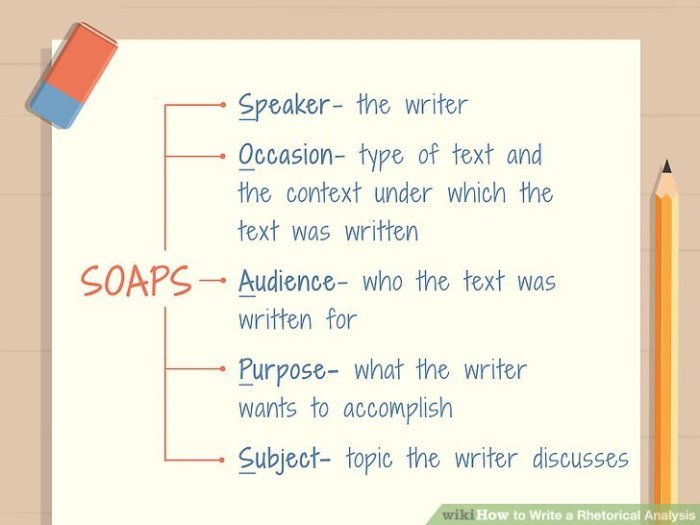
- Identifying the Rhetorical Situation: The rhetorical situation comprises the elements influencing the creation and reception of the communication. Determine the author/speaker, their purpose in creating the message, and the intended audience. Analyze the subject matter, the constraints (factors limiting the author), and the exigence (the motivating factor that prompted the communication). Understanding the rhetorical situation provides a framework for analyzing the message’s effectiveness.
- Analyzing the Appeals (Ethos, Pathos, and Logos): Examine how the communication utilizes the three classical rhetorical appeals:
- Ethos (Credibility): Evaluate how the author establishes credibility and trustworthiness. Consider the author’s expertise, character, and the presentation of their ideas.
- Pathos (Emotion): Identify the emotional appeals used to engage the audience. Analyze the language, imagery, and other techniques that evoke feelings and influence the audience’s response.
- Logos (Logic): Assess the logical arguments presented. Examine the evidence, reasoning, and structure of the arguments. Look for fallacies or inconsistencies that might undermine the message.
- Identifying Rhetorical Devices: Analyze the specific rhetorical devices employed to enhance persuasion. These can include metaphors, similes, rhetorical questions, repetition, and other figures of speech. Identify how these devices contribute to the message’s impact and effectiveness. The choice and implementation of these devices can reveal significant insights into the author’s persuasive strategy.
- Analyzing the Structure and Organization: Examine the overall structure and organization of the communication. Consider the order of arguments, the use of transitions, and the overall flow of the message. How does the structure contribute to the message’s clarity, coherence, and persuasiveness?
- Evaluating the Effectiveness: Based on the analysis of the previous steps, evaluate the effectiveness of the communication. Does it achieve its intended purpose? Does it resonate with the intended audience? Consider the strengths and weaknesses of the communication and how it might be improved. This final evaluation synthesizes all prior findings.
- Formulating an Interpretation and Conclusion: Synthesize the findings into a coherent interpretation of the communication. Summarize the author’s strategies, their impact, and the overall meaning of the message. Draw conclusions about the message’s effectiveness and its implications. This final step brings together all elements of the analysis.
Example of a Successful Application of this Procedure
Consider a hypothetical scenario: analyzing a public service announcement (PSA) about the importance of recycling. The following table illustrates how the step-by-step procedure could be applied, demonstrating the results of the rhetorical scrutiny.
| Step | Description | Analysis of the Recycling PSA | Results |
|---|---|---|---|
| 1. Initial Observation and Contextualization | Observe the medium, format, and overall impression. Research the context. | The PSA is a short video, broadcast on television during prime time. It features children talking about the importance of recycling, set against a backdrop of a clean, green environment. The context involves growing environmental awareness and the need for sustainable practices. | The PSA aims to connect with viewers on an emotional level by using children as messengers and highlighting a positive vision. |
| 2. Identifying the Rhetorical Situation | Determine the author, purpose, audience, subject, constraints, and exigence. | Author: Environmental Protection Agency (hypothetical). Purpose: To encourage recycling. Audience: General public, particularly families. Subject: Importance of recycling. Constraints: Limited time and budget. Exigence: Growing waste problem and need for environmental protection. | The PSA leverages the urgency of environmental issues to motivate the audience. |
| 3. Analyzing the Appeals (Ethos, Pathos, and Logos) | Examine the use of Ethos, Pathos, and Logos. | Ethos: The EPA’s authority lends credibility. Pathos: Uses children to evoke emotions of care and responsibility. Logos: Presents a simple message about the benefits of recycling. | The PSA uses a balanced approach to persuasion, combining credibility, emotional appeals, and logical reasoning. |
| 4. Identifying Rhetorical Devices | Analyze the use of rhetorical devices. | Uses imagery of clean environments (metaphor for a better future), simple language for easy understanding (rhetorical question) and repetition of the recycling message. | These devices enhance the PSA’s clarity, memorability, and emotional impact, thereby increasing the effectiveness of the message. |
Exploring the Role of Context in Shaping Rhetorical Messages
The impact of context on rhetorical messages is profound, shaping both their creation and their reception. Understanding the historical, social, and cultural backdrop is crucial for deciphering the nuances of any persuasive communication. This context provides the framework through which a message is understood, influencing everything from the choice of language to the effectiveness of the arguments presented.
Contextual Influences on Message Interpretation
The interpretation of a message is significantly altered by the context in which it is received. Different environments lead to varying perceptions, highlighting the importance of considering the audience’s background.
- Historical Context: A speech delivered during wartime will be interpreted differently than the same speech given during peacetime. The audience’s awareness of current events, past conflicts, and prevailing ideologies will heavily influence their understanding. For instance, a call to arms during a period of national crisis resonates differently than the same appeal during a period of international peace.
- Social Context: Social norms, values, and power dynamics play a crucial role. A message targeting a specific social group will be received based on their shared experiences and beliefs. Consider the impact of a celebrity endorsement. Its effectiveness hinges on the audience’s perception of the celebrity’s social standing and the alignment of the product with their values.
- Cultural Context: Cultural traditions, beliefs, and communication styles shape how a message is received. What is considered persuasive in one culture may be ineffective or even offensive in another. Directness in communication, for example, is valued in some cultures, while others prioritize indirectness and subtlety.
Rhetorical Strategies During the Cuban Missile Crisis
The Cuban Missile Crisis, a pivotal moment in the Cold War, offers a compelling example of how historical context shaped persuasive strategies. The threat of nuclear war created an environment of extreme tension and fear, influencing the rhetoric employed by key figures.
The crisis, which unfolded in October 1962, involved the Soviet Union’s placement of nuclear missiles in Cuba, sparking a thirteen-day standoff between the United States and the Soviet Union. This event presented a direct threat to the United States and its allies. The stakes were incredibly high, with the potential for a global nuclear conflict.
President John F. Kennedy’s address to the nation on October 22, 1962, is a prime example of context-driven rhetoric. Kennedy framed the situation as a grave threat to national security and global stability. He employed a combination of strategies:
“It shall be the policy of this nation to regard any nuclear missile launched from Cuba against any nation in the Western Hemisphere as an attack by the Soviet Union on the United States, requiring a full retaliatory response upon the Soviet Union.”
Kennedy’s use of strong, decisive language aimed to reassure the American public and deter further Soviet aggression. The speech, broadcast on television, was designed to create a sense of unity and resolve. He emphasized the importance of international cooperation, framing the crisis as a global challenge. The impact of the speech was amplified by the historical context: the ongoing Cold War, the fear of nuclear annihilation, and the perceived vulnerability of the United States. Kennedy’s measured tone, combined with the gravity of the situation, aimed to balance the need for firmness with the avoidance of escalation.
Evaluating the Effectiveness of Rhetorical Strategies
Assessing the success of rhetorical strategies is a crucial step in understanding how communication influences its audience. It moves beyond simply identifying the devices used and delves into the impact those devices have on persuasion, understanding, and action. This evaluation process involves a combination of analyzing the text itself, considering the context in which it was delivered, and, crucially, measuring the response of the intended audience. The goal is to determine whether the strategies employed achieved their desired effect, whether that was to inform, persuade, entertain, or incite action.
Methods for Measuring Message Impact
To determine the effectiveness of rhetorical strategies, several methods can be employed to gauge audience response and assess the impact of the message. These methods provide a framework for gathering data and drawing conclusions about the success of the communication. The selection of methods should be tailored to the specific communication and its objectives.
- Surveys and Questionnaires: These structured tools are designed to collect quantitative and qualitative data directly from the target audience. They can assess changes in attitudes, beliefs, and behaviors before and after exposure to the message. Questions can range from multiple-choice to open-ended, allowing for both breadth and depth of understanding.
- Focus Groups: Facilitated discussions with small groups of individuals provide a platform to explore audience reactions in detail. The moderator guides the conversation, probing for deeper insights into the emotional and cognitive responses triggered by the message. This method is particularly useful for uncovering nuances and unspoken perceptions.
- Behavioral Tracking: Measuring actual actions taken by the audience is a powerful indicator of effectiveness. This can include tracking website traffic, sales figures, social media engagement (likes, shares, comments), or attendance at events. These metrics provide concrete evidence of the message’s impact on behavior.
- Content Analysis: This method systematically analyzes the content of audience responses, such as social media comments, reviews, or letters to the editor. It identifies recurring themes, sentiments, and language patterns, providing insights into how the message was interpreted and received.
- Eye-Tracking and Physiological Measures: Advanced techniques, such as eye-tracking, can monitor where and how long an individual’s gaze focuses on specific elements of a message. Physiological measures, such as heart rate and skin conductance, can provide insights into the emotional impact of the communication.
Evaluating a Public Health Campaign
Consider a public health campaign aimed at increasing vaccination rates among young adults (ages 18-25) in a specific city. The campaign, titled “Protect Yourself, Protect Others,” utilizes a multi-platform approach, including social media advertisements, public service announcements on local radio stations, and posters displayed in public spaces. The campaign’s primary rhetorical strategy is to appeal to both the audience’s sense of self-preservation and their sense of social responsibility. The campaign also features testimonials from young adults who have been vaccinated and experienced no adverse effects.
The target audience is young adults who are hesitant or undecided about vaccination. The campaign’s measurable outcomes would include:
- Vaccination Rates: The primary measure of success would be an increase in the number of young adults receiving vaccinations within the city. Data would be collected from local health clinics and pharmacies.
- Social Media Engagement: The campaign’s social media channels would be monitored for metrics such as likes, shares, comments, and the overall sentiment (positive, negative, neutral) expressed by users. A significant increase in positive engagement would indicate a positive response.
- Website Traffic: The campaign would have a dedicated website with information about vaccines and local vaccination sites. Tracking website traffic, particularly the number of unique visitors and the time spent on key pages, would indicate audience interest.
- Survey Data: Pre- and post-campaign surveys would be administered to a representative sample of young adults. These surveys would assess changes in attitudes towards vaccination, perceived risks and benefits, and intentions to get vaccinated. The surveys would include questions designed to gauge their understanding of the campaign’s messages and their perception of the campaign’s credibility.
- Focus Group Discussions: Several focus groups would be conducted to explore in-depth the audience’s reactions to the campaign’s messaging, imagery, and overall effectiveness. The discussions would explore any lingering concerns or questions that might need to be addressed in future communications.
If the campaign results in a measurable increase in vaccination rates, a rise in positive social media engagement, increased website traffic, and a shift in survey responses towards more favorable attitudes towards vaccination, then the campaign can be considered rhetorically effective.
Differentiating Between Various Types of Rhetorical Styles
The art of persuasion is not a monolithic entity. It manifests in diverse forms, each tailored to a specific context, audience, and objective. Understanding these variations, from the meticulously crafted oration to the casual exchange, is crucial for both crafting and deciphering persuasive messages. The choice of rhetorical style significantly influences the message’s impact, dictating how information is received and understood. The ability to distinguish between these styles is a cornerstone of effective communication and critical analysis.
Comparing and Contrasting Rhetorical Styles
The following table provides a comparative analysis of three primary rhetorical styles: formal speeches, informal conversations, and written texts. Each style presents unique characteristics influencing its effectiveness.
| Characteristic | Formal Speech | Informal Conversation | Written Text |
|---|---|---|---|
| Purpose | To inform, persuade, or commemorate a large audience; often used for significant events or announcements. | To exchange information, build relationships, or express personal opinions in a casual setting. | To convey information, persuade, entertain, or document ideas; intended for a potentially wider and more diverse audience. |
| Audience | Generally a large, assembled group; often with a predefined expectation of the speaker’s authority or expertise. | Typically a small group of individuals; the audience’s knowledge and relationship with the speaker are often key. | Varies greatly, ranging from a specific target demographic to a general readership; the writer may or may not know the audience directly. |
| Language | Precise, elevated, and often stylized; relies on carefully chosen vocabulary and rhetorical devices; uses structured sentence patterns. | Colloquial, conversational, and often spontaneous; relies on informal language, slang, and nonverbal cues; sentence structure is typically less formal. | Varies depending on the genre and intended audience; can range from highly formal to extremely informal; employs a wide range of vocabulary and grammatical structures. |
| Delivery | Delivered with deliberate pacing, clear articulation, and often accompanied by nonverbal cues (gestures, eye contact); usually rehearsed or prepared. | Spontaneous, interactive, and reliant on immediate feedback; relies heavily on tone of voice, facial expressions, and body language. | Requires careful editing and revision; the delivery is indirect, conveyed through typography, layout, and visual elements. |
Demonstrating the Impact of Rhetorical Style Choice
The selection of a rhetorical style dramatically affects the overall impact of a message. Consider the following scenarios:
* Scenario 1: Formal Speech. Imagine a CEO delivering a speech at a company-wide town hall meeting. The audience consists of employees from various departments, ranging from entry-level staff to senior management. The setting is a large auditorium, equipped with a stage, microphones, and projection screens. The CEO’s goal is to announce a significant restructuring plan. The formal style, characterized by its structured language, measured delivery, and emphasis on authority, would be crucial. The formal tone, using carefully chosen vocabulary, projects competence and control, thus creating a sense of assurance and credibility. A less formal approach, such as casual language, would undermine the gravity of the announcement and potentially erode employee trust. The structured nature allows for a comprehensive presentation of complex information, which the diverse audience needs to comprehend.
* Scenario 2: Informal Conversation. A group of friends is discussing a recent political event at a coffee shop. The setting is relaxed, the atmosphere casual, and the audience is a group of peers with shared experiences and values. The language is informal, using slang and humor, and the tone is conversational. The focus is on sharing personal opinions and experiences. In this scenario, a formal speech would be entirely inappropriate and counterproductive. It would appear stilted, out of touch, and likely alienate the listeners. Instead, the informal style fosters a sense of camaraderie and allows for a more open exchange of ideas. This allows for a more natural flow of conversation, using shared context and understanding.
* Scenario 3: Written Text. Consider a scientific paper published in a peer-reviewed journal. The audience is comprised of experts in a specific field, and the setting is the academic world. The style is highly formal, using precise language, technical jargon, and rigorous argumentation. The goal is to present original research and contribute to the existing body of knowledge. A less formal style, such as a blog post, would be inappropriate for this context. The precise language and adherence to academic conventions are essential for conveying the research findings accurately and establishing credibility within the scientific community. The format demands detailed citations, data analysis, and adherence to established methodological principles.
These examples illustrate that the choice of rhetorical style must align with the context, the audience, and the purpose of the message. The success of any persuasive communication hinges on this critical alignment.
Examining the Ethical Considerations in Rhetorical Practices
The art of rhetoric, while a powerful tool for communication and persuasion, carries significant ethical responsibilities. The techniques employed to influence audiences can be used for good, promoting understanding and positive change, or for ill, manipulating individuals and perpetuating harm. A thorough understanding of these ethical implications is crucial for anyone engaging in rhetorical practices, whether as a speaker, writer, or consumer of persuasive messages. The responsible use of rhetoric requires careful consideration of the potential impact of one’s words and a commitment to honesty, fairness, and respect for the audience.
Ethical and Unethical Applications of Persuasive Techniques
The effectiveness of rhetorical devices hinges on their application. It is important to differentiate between responsible and irresponsible applications of these techniques. Consider that
“Rhetoric is a tool; it is neither inherently good nor bad, but its use can be judged on ethical grounds.”
- Responsible Use:
- Presenting factual information accurately and avoiding deliberate misinformation. This builds trust with the audience and fosters informed decision-making.
- Acknowledging opposing viewpoints fairly and respectfully, even when disagreeing. This demonstrates intellectual honesty and promotes open dialogue.
- Appealing to emotions in a way that is genuine and proportionate to the subject matter, avoiding manipulative tactics. For instance, a charity’s appeal might show the actual impact of donations without exaggerating the situation.
- Using language that is inclusive and avoids perpetuating stereotypes or prejudices. This ensures that the message is accessible and respectful to all members of the audience.
- Irresponsible Use:
- Spreading false or misleading information to deceive the audience. This undermines trust and can lead to harmful consequences.
- Suppressing or misrepresenting opposing viewpoints to create a biased narrative. This limits critical thinking and can prevent informed decision-making.
- Using fear, guilt, or other strong emotions to manipulate the audience, often without providing sufficient evidence. A classic example is the use of fear-mongering in political campaigns.
- Employing language that is discriminatory or offensive, perpetuating prejudice and marginalizing certain groups. This can have a devastating impact on individuals and society.
A Scenario Illustrating Ethical Concerns
Consider a scenario involving two characters: Sarah, a marketing executive, and David, a small business owner. Sarah is tasked with promoting a new line of weight-loss supplements for her company. David, struggling to keep his independent health food store afloat, is approached by Sarah to partner in the marketing campaign. Sarah knows the supplements’ effectiveness is questionable, and the scientific evidence is limited. However, she believes she can leverage persuasive techniques to generate sales. She focuses on testimonials from individuals who may have experienced a placebo effect, downplaying potential side effects and exaggerating the supplements’ benefits. She crafts advertisements that appeal to consumers’ insecurities about their weight, using images of slim, attractive models and employing emotionally charged language to create a sense of urgency. David, initially hesitant, sees the potential for increased revenue and agrees to participate. He is aware of the ethical concerns but rationalizes his actions by focusing on the financial benefits. This situation highlights ethical dilemmas: Sarah’s dishonesty in marketing, David’s complicity in misleading consumers, and the potential for the supplements to harm people.
Last Word
In essence, rhetorical analysis is a powerful tool for understanding and navigating the persuasive world around us. From dissecting the core components of persuasive communication to evaluating the effectiveness of rhetorical strategies, the ability to analyze rhetoric provides a deeper comprehension of how messages are crafted and received. By examining the context, ethical implications, and various styles of persuasive communication, we gain the ability to critically assess information, become more effective communicators, and ultimately, become more informed participants in the world around us. The journey into the heart of persuasion is a journey of empowerment, transforming passive recipients into active, discerning thinkers.
